

An overhead door that stops working reliably affects more than just convenience. For homeowners, it is a daily access point and a security layer. For property managers and commercial facilities, it is an operational dependency that affects tenants, deliveries, and staff. When an overhead door develops a problem in Los Angeles, getting a licensed technician on site quickly, with the right parts and the diagnostic experience to identify the actual cause rather than the most obvious symptom, is what separates a resolved problem from a recurring one.
SoCal Garage Door and Gates provides overhead door repair across Los Angeles for residential and commercial properties, with licensed and insured technicians and same-day service available for urgent issues. This guide covers what overhead door repair actually involves, the most common failure types in the Los Angeles market, and how to evaluate whether repair or replacement is the right path forward.
What an Overhead Door System Actually Consists Of
Understanding what is in an overhead door system helps homeowners and property managers have more productive conversations with technicians and make better decisions about repair and maintenance. An overhead door is not a single component. It is a system of mechanically and electrically interdependent parts, and a failure anywhere in that system can affect the performance of every other part.
The door itself consists of panel sections connected by hinges that allow the door to fold and travel along curved tracks from the vertical opening position to the horizontal overhead position. The tracks guide the door through that arc and need to be properly aligned both vertically and horizontally for smooth operation. Rollers ride inside the tracks and are one of the most wear-prone components in the system because they cycle on every open and close.
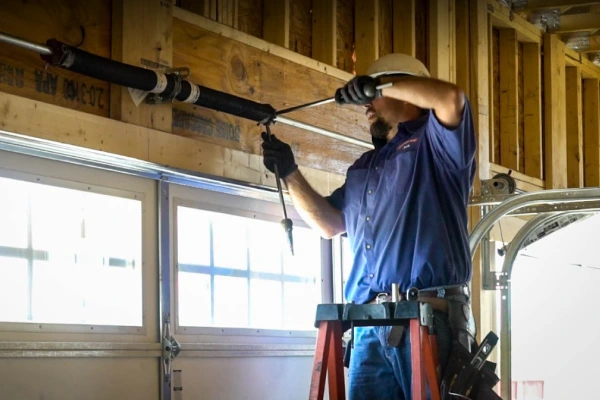
The spring system is what makes the door operable. Torsion springs mounted above the door opening or extension springs running along the horizontal tracks store and release mechanical energy to counterbalance the door’s weight. Without functioning springs, the door cannot be lifted by the opener motor and is very difficult to operate manually. The cables connect the springs to the door and transfer the counterbalancing force to the bottom corners of the door during operation.
The opener is the motorized unit that automates the door’s movement. It connects to the door via a trolley and drive system, processes commands from remotes and wall buttons through a logic board, and governs the door’s travel limits and safety reversal behavior. Safety sensors mounted near the floor detect obstructions and signal the opener to stop or reverse. All of these components work together, and a thorough repair assessment covers all of them.
The Most Common Overhead Door Problems in Los Angeles
Los Angeles properties present specific conditions that affect overhead door system wear. The combination of warm to hot temperatures across most of the year, significant temperature swings in inland neighborhoods like the San Fernando Valley and the San Gabriel Valley, seismic activity that gradually shifts concrete slabs and door frames, and the dense urban environment where garages often share walls with living spaces all contribute to failure patterns that show up more frequently here than in other parts of the country.
Spring failures are the most common repair call by volume. Torsion springs are rated for approximately 10,000 cycles under standard conditions, which translates to roughly 7 to 14 years of daily use depending on how often the door operates. Springs that are undersized for the door weight, that have never been lubricated, or that have been running in a high-temperature garage environment in a hotter LA neighborhood fail more quickly than the cycle rating suggests. When a spring breaks, the sound is often described as a loud bang coming from the garage, and the door will typically not open with the automatic opener after that.
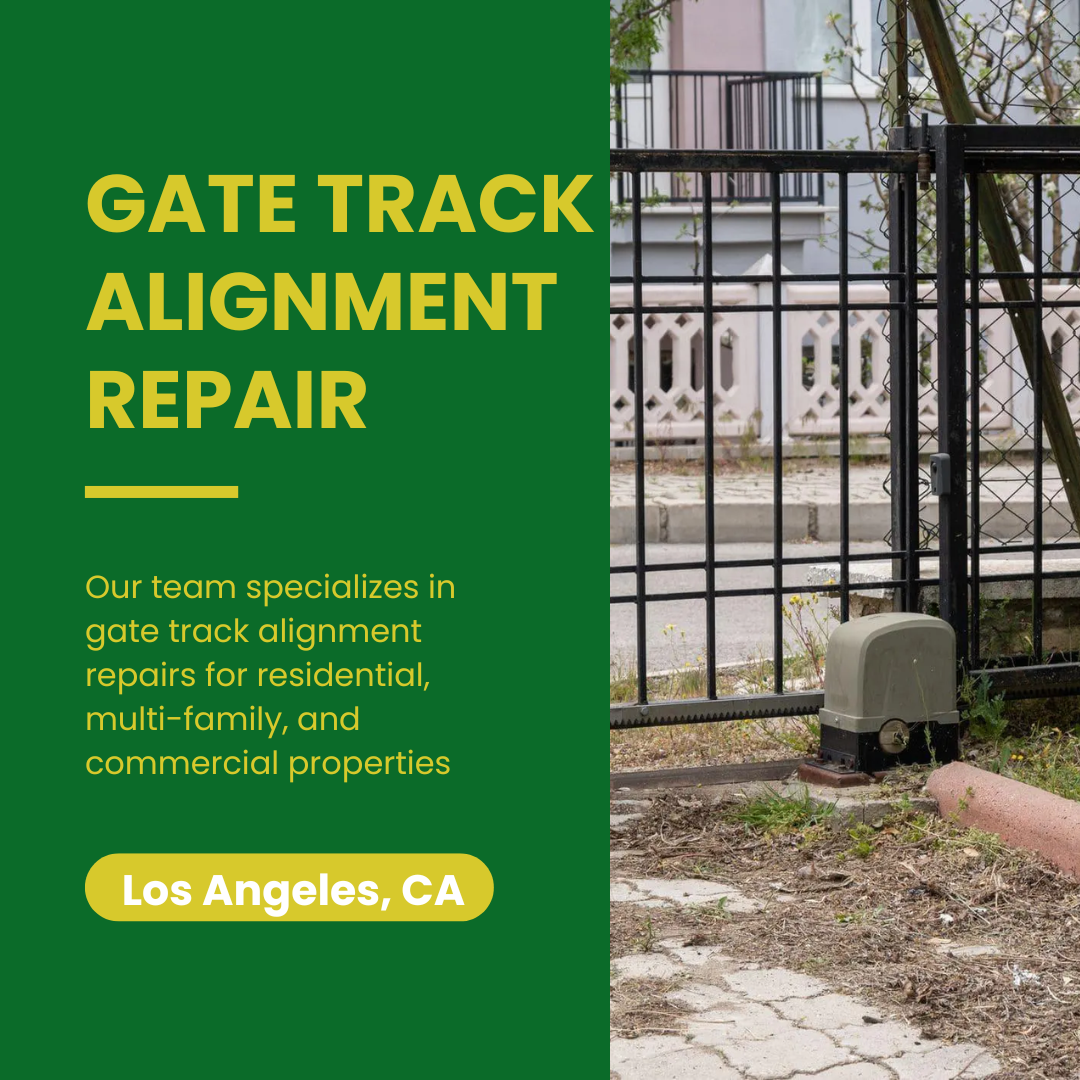
Track misalignment develops gradually on properties where ground movement is a factor. In Los Angeles, where minor seismic activity is a regular occurrence and expansive clay soils shift with seasonal moisture changes, tracks that were properly aligned at installation can drift out of position over years of use. A door that makes a grinding or scraping sound during operation, that appears to lean slightly to one side, or that has visible gaps between the rollers and the track at certain points in its travel usually has an alignment issue.
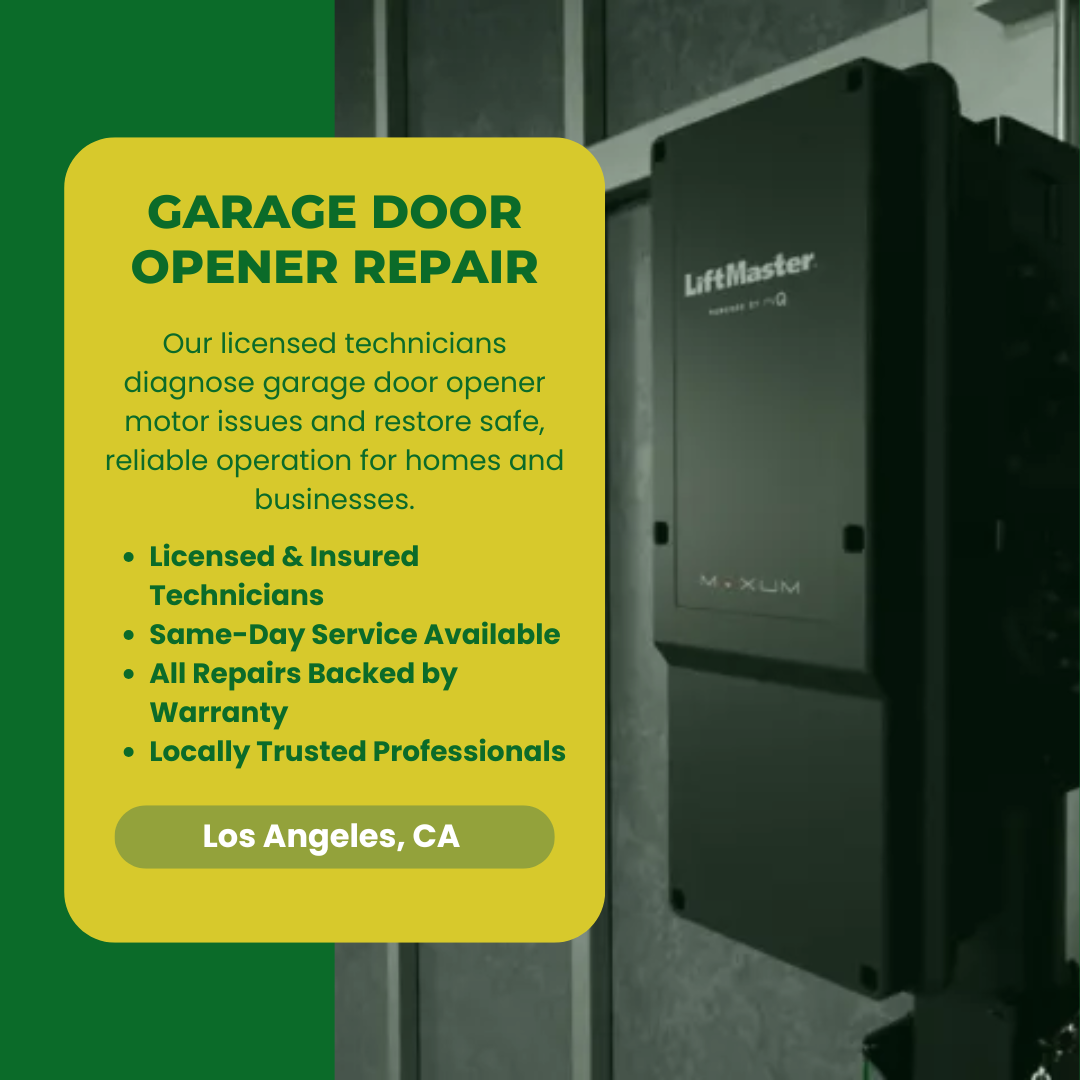
Opener failures in Los Angeles often trace to heat and age combined. Garage temperatures in interior neighborhoods of Los Angeles regularly exceed 100 degrees during summer, and that sustained heat accelerates wear on the capacitor, the logic board, and the motor windings inside the opener. Openers that are approaching or past the 10-year mark and showing signs of labored operation, intermittent response, or increasing noise are typically entering the failure window rather than the safe middle of their service life.
Panel damage from vehicle impact is among the most visually obvious overhead door problems and the one most homeowners recognize immediately. A dented or misaligned panel affects not just appearance but door function, because a bent panel section creates resistance in the track and hinge system that adds stress to the opener motor and can accelerate spring wear. Single panel replacement is possible on most sectional door systems, provided the replacement panel can be matched to the existing sections.
Roller and cable wear are the two failure types most commonly missed until they cause a secondary problem. Rollers that have worn through their nylon coating create metal-on-metal contact with the track that generates noise and vibration. Cables that have developed visible fraying are under stress and should be replaced before they snap, because a cable failure under load can cause the door to drop suddenly or operate at an angle that damages the track and frame.
Repair vs Replacement: How to Think About the Decision
The repair-versus-replace decision on an overhead door follows a consistent logic that experienced technicians use to give honest assessments. If the door is less than 10 years old and the failure is an identifiable single component, repair is almost always the more economical path. Springs, cables, rollers, openers, and individual panels are all field-replaceable parts, and addressing the specific failure while the rest of the system still has service life is straightforward.
When the door is 15 or more years old and showing multiple issues simultaneously, the calculus shifts. An older door that needs a spring replacement today, has visibly worn rollers, and has an opener that is running laboriously is essentially running on borrowed time. Replacing the spring extends the life of the door but does not address the other wear items, and each subsequent repair adds cost to a system that may need full replacement within a year or two regardless.
The condition of the door panels and frame also matters in this decision. Steel panels that are dented, rusting at the edges, or showing paint failure on multiple sections are past the point where individual repairs make long-term sense. At that stage, a full door replacement delivers better value than continued investment in an aging system.
For commercial properties with overhead doors that see very high daily cycle volumes, the calculation often involves maintenance contracts that schedule preventive service before components reach the failure point, which reduces unplanned downtime and extends system lifespan.
What to Expect from a Same-Day Overhead Door Repair
A proper overhead door repair service begins with a complete system assessment, not a parts swap based on the most visible symptom. SoCal Garage Door and Gates technicians inspect the full system on every service call: spring condition, cable integrity, roller wear, track alignment, opener function, sensor calibration, and panel and hardware condition. This approach identifies issues that have not yet caused a noticeable symptom but that would become the next service call if left unaddressed.
Same-day repair capability depends on the technician having the right parts on hand. SoCal Garage Door and Gates vehicles carry inventory covering the most common repair components for residential and commercial overhead door systems across Los Angeles, which makes same-day completion the standard outcome on most service calls rather than a best-case scenario.
After repairs are completed, the system is tested through multiple full cycles, the safety auto-reverse function is verified, and the technician confirms that remote and wall button communication is working correctly before the service call is closed.
If your overhead door is not operating correctly anywhere in Los Angeles, call SoCal Garage Door and Gates at (800) 897-6858 or visit lagaragedoorandgates.com to schedule same-day service with a free on-site assessment.